
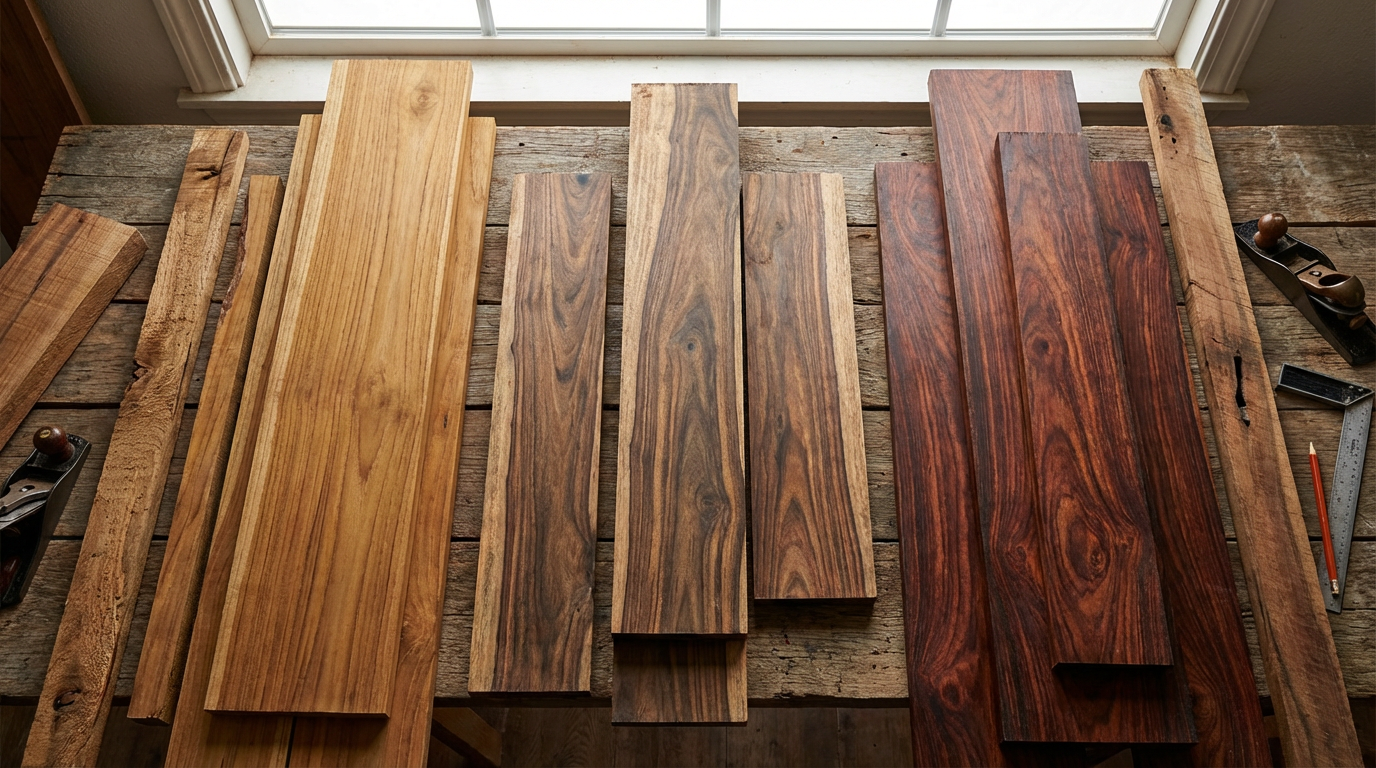
A wood quality furniture buying guide for anyone investing in solid wood furniture in India.
Walk into any furniture market in India — from Kirti Nagar in Delhi to the wholesale corridors of Jaipur — and you will hear the words “teak” and “rosewood” spoken with confidence. They signal quality, longevity, and value. The problem is that these words are often applied loosely, sometimes inaccurately, and occasionally in commercially convenient ways rather than technically correct.
This is especially important when investing in solid wood furniture in India—whether for a private residence, a hospitality project, or a bespoke interior. Handcrafted furniture is only as good as the material it begins with. And if that material is misrepresented at the source, no amount of craft can recover what was lost before the first cut.

First, Understand the Tree: Heartwood vs. Sapwood
Every tree trunk has two distinct zones.
The outer ring, just beneath the bark, is sapwood — the living, active part of the tree. It is younger, softer, more porous, and has little natural oil content. It is considerably more vulnerable to moisture, fungal attack, and insect damage.
The inner core is heartwood. As a tree matures, the inner cells die and transform — depositing resins, oils, and tannins into the wood’s cellular structure. This is what darkens the wood and gives premium species their durability. Heartwood is denser, harder, naturally resistant to rot and insects, and far more dimensionally stable.
Understanding heartwood vs sapwood is one of the most important things a buyer of solid wood furniture in India can know. Grade A teak comes exclusively from mature heartwood — where oil concentration is highest. Grade C teak comes primarily from sapwood, contains very little natural oil, and can fail within years under conditions that Grade A handles without difficulty. Same species. Very different furniture.
A visible clue: heartwood is always darker than sapwood from the same tree. Irregular pale patches or streaks in an otherwise dark piece are sapwood inclusions — worth noting when evaluating quality.

Teak: One Name, Multiple Realities
True teak — botanically Tectona grandis — is native to the tropical forests of South and Southeast Asia. What makes it exceptional is not its appearance but its internal chemistry. The heartwood of a mature Tectona grandis contains high concentrations of natural oils and silica that make the wood self-protecting — resistant to moisture, rot, warping, and termites without any external treatment. This is not a surface coating. It is built into the wood itself.
This is what makes teak wood furniture a long-term investment — when the wood is genuine.
“African Teak” is a trade name commonly applied to Afromosia (Pericopsis elata), native to West Africa. Is African teak the same as Indian teak? No — in any botanical sense. Afromosia lacks the natural oil content that defines Tectona grandis, and that oil content is not incidental. It is the primary reason genuine teak performs the way it does in India’s demanding climate of heat, monsoon humidity, and temperature cycling.
When commissioning custom furniture for a premium residential or hospitality project, this distinction directly affects how a piece performs over decades.

Sheesham vs Rosewood: A Confusion the Market Has Quietly Accepted
Sheesham (Dalbergia sissoo) — North Indian Rosewood — is a genuinely good furniture wood. Golden to dark brown heartwood, it works well with hand tools, takes an excellent polish, and is reasonably durable. Its relative accessibility makes it one of the most widely used woods in Indian furniture manufacturing.
Indian Rosewood (Dalbergia latifolia) — East Indian Rosewood or Bombay Blackwood — is a different species entirely. Slow-growing, dense, and deeply beautiful, with heartwood ranging from golden brown to deep purplish-brown with distinctive dark streaks. It is harder, heavier, and significantly more durable. It is also classified as vulnerable on the IUCN Red List due to decades of over-harvesting — making it genuinely rare and legally restricted in trade.
Dalbergia latifolia can command many times the price per cubic meter of Dalbergia sissoo. Well-made pieces from genuine Indian rosewood are known to last well over a century. When “rosewood” furniture is quoted at an accessible price, it is almost always Dalbergia sissoo — not necessarily a problem, but worth knowing.


How Mislabelling Actually Happens
A timber trader imports African hardwood and calls it “African teak” — a recognised international trade term. The sawmill sells it to a workshop as “teak.” The workshop sells the finished piece to a retailer as “teak.” By the time the label reaches the buyer, the word “teak” has passed through four or five people — none of whom may have been lying by their own understanding — and yet the wood is not Tectona grandis.
This is structural, not always intentional. Which is exactly why the point of purchase is where you need to ask the right questions.

What to Ask Before You Buy
Whether you are working with a furniture manufacturer in Jaipur, specifying for a hospitality project, or investing in custom-made furniture for your home:
- What is the botanical species name of this wood?
- Is this heartwood or sapwood — or a mix?
- Has this wood been properly seasoned? Unseasoned wood warps and cracks as it dries inside a finished piece.
- Is this solid wood throughout, or veneer over engineered wood?
A maker who knows their material will answer all of these without hesitation.
Material Integrity Is Where Craft Begins
The best luxury furniture in India — pieces that genuinely earn that description — begins with material honesty. The species, the grade, the cut, the seasoning. These cannot be recovered in the workshop if they are wrong at the source.
For architects and interior designers specifying custom furniture for clients, this knowledge is part of the service you provide. For homeowners making a significant investment, it is simply due diligence.

At Heimod, every piece begins with a material conversation. We work with solid woods chosen by species, grade, and application — and we will always tell you exactly what you are getting, and why.
Leave a Reply